The strange case of Ulmus 43-8
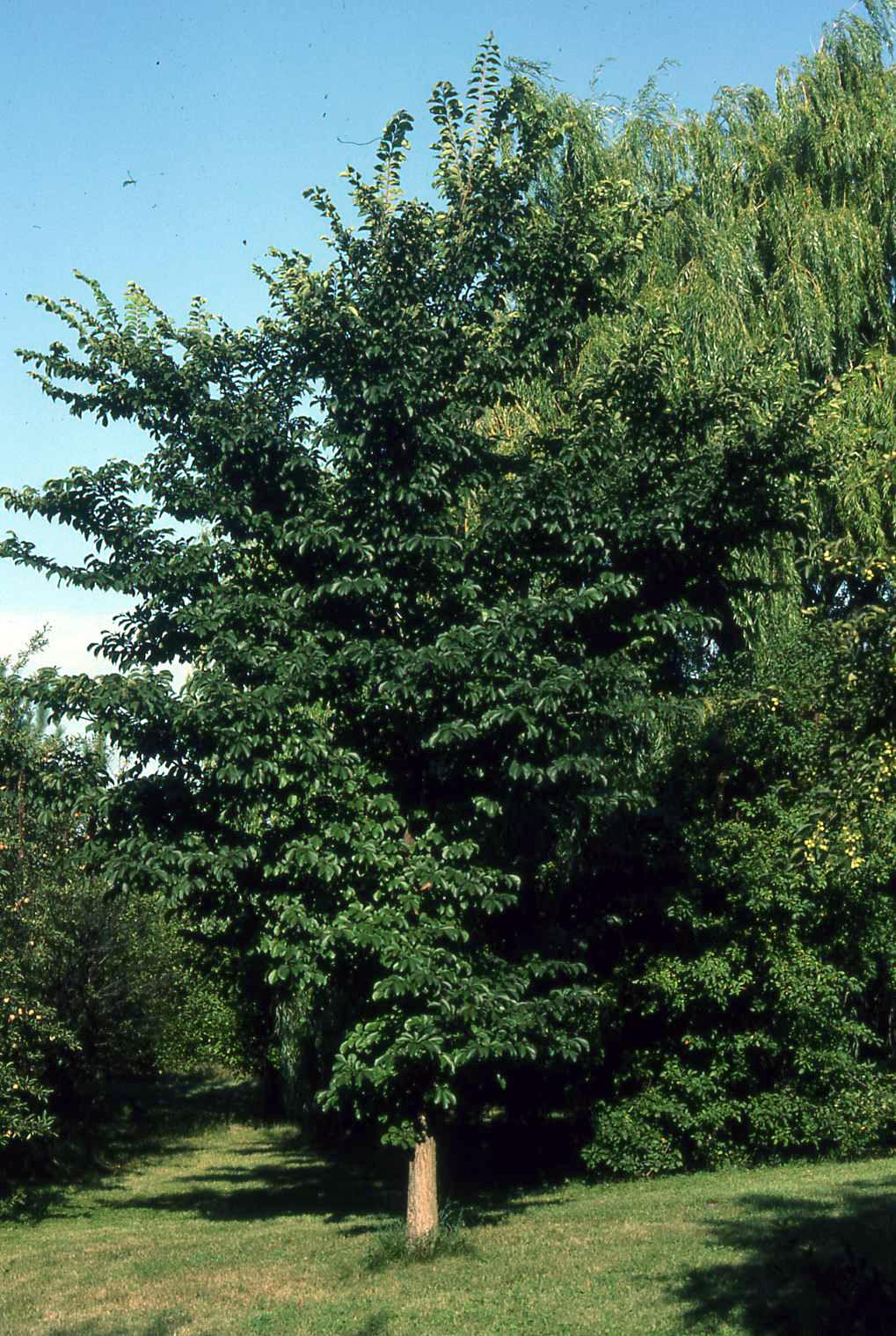
43-8: 11 years old (Ray Guries)
The hunt for 43-8, once known as “Reseda”, began in 2010 on the basis of an American web publication called “How to Identify and Manage Dutch Elm Disease”, by Linda Haugen. Among its illustrations is a photograph with the caption “This selection of Ulmus japonica [Japanese Elm] demonstrates the potential these elms have as landscape trees”. It is credited to Eugene Smalley, one of the greatest of the US elm breeders, who died in 2002.
The photograph did indeed show a tree with obvious landscape potential – a young elm fully furnished with dark, slightly glossy foliage, identifiably Japanese in its lower leafing but strikingly similar to English or at least Dutch elm in the balance and growth patterns of its upper canopy. The chances of ever matching a name to it seemed remote.
But in the summer of 2011 the photograph reappeared, newly added to the Wikipedia page dealing with Ulmus “Reseda” (43-8). The image seems to have been one of several received by Ronnie Nijboer of the Dutch nursery Bonte Hoek from Smalley’s former colleague Ray Guries at the University of Wisconsin-Madison. The photos were of the elm 43-8 still growing in Smalley’s 20 acre garden at Cottage Grove, Madison.
43-8 was among the trees which grew from U. japonica seed received by Smalley in the late 1950s from the University of Hokkaido, Japan. The Wikipedia page stated that 43-8 had been dispatched by Smalley, along with other clones, to the Conrad Appel nursery in Darmstadt, Germany, which later became Eisele GmbH. The tree had been named “Reseda” and briefly enjoyed patent protection until its resistance to disease was found to be only moderate. Eisele thereupon dropped it. Later, it became confused, unaccountably, with a pendulous form of Siberian elm. So if any trees identified as 43-8 still existed in Germany, they might or might not be the “right” 43-8.
Correspondence with Christoph Eisele deepened the intrigue. Amongst the documents received from him was one which quoted Smalley as saying of 43-8 in 1990:

43-8: 12 years old (Ray Guries)
“… it’s a beautiful tree, but grows much slower than W44-26 (Cathedral), and will quickly be shaded out in dense plantings in competition with the faster growing hybrids. The mechanism of resistance may be of interest. In some of our field trials it does occasionally show a small degree of foliar wilt. But unlike U. carpinifolia [ie. U. minor, the field elm], to which it is botanically related, most of the wilting branches refoliate in the same season and only limited damage results the following year. I anticipate that the level of rooting for this clone will be lower than Regal, but I consider it a very high value ornamental tree, and perhaps the most beautiful tree in our collection for landscape purposes. It should be well worth the slower propagation and should get a premium price in the market place”.
It is then pointed out in German that Smalley never wrote such a long commentary on any of his other clones.
A hand-written annotation to this document states that “there is one growing in C. Eisele’s garden”. Christoph Eisele was kind enough to send a spray of leaves from this tree. However, with the accompanying documentation there is also a photocopy of leaves of 43-8 dated October 1993. They are double the size of the leaves received from Herr Eisele, and differ from them in several other respects as well. At around this time, Ronnie Nijboer and Matthias Eisele inspected the trees in Darmstadt which were putatively 43-8 plantings, and concluded that none of them in fact was.
It seems that 43-8 was sent by Smalley to Darmstadt in the belief that its resistance was satisfactory. This is borne out by information given with the US patent for the tree later named “Cathedral” which remains in commerce to this day; results for 43-8 happen to be included here and it seems to have outperformed “Cathedral”. When 43-8 was screened for resistance in Darmstadt, in Herr Eisele’s words “it did not behave as it should”. He suspects that there was a mix-up either in Madison or in Darmstadt.
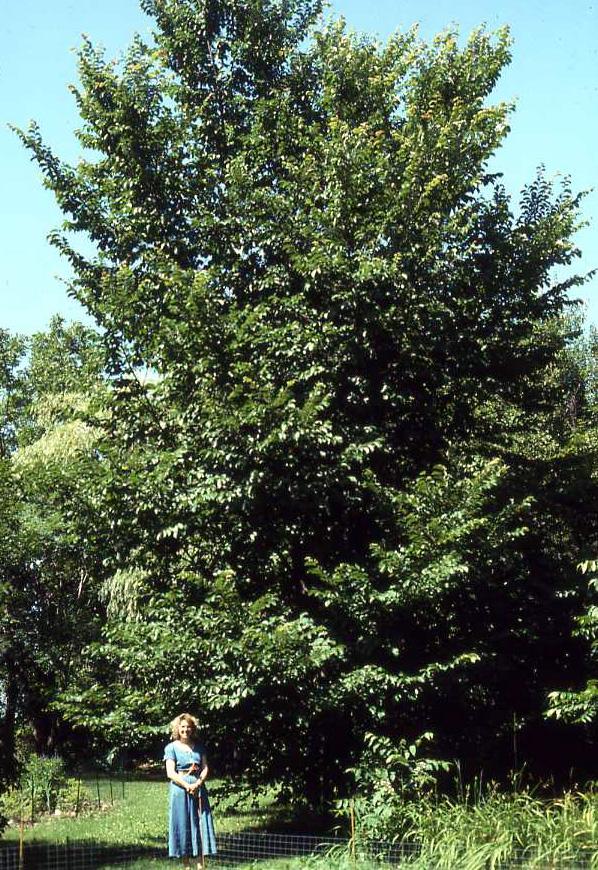
43-8: 18 years old (Ray Guries)
With the documentation received from Eisele is a type-written but undated sheet with comments in German on various aspects of 43-8. With regard to resistance, it states that a first test in 1993 involved two plants of which one showed 25% wilting. This is followed by the sensible conclusion that no assessment can be based on so limited a trial. Crucially, it remains unclear whether further testing did in fact take place.
More than one conclusion could be drawn. One is that a mix-up in nursery production did occur between testing in Wisconsin and its repetition in Darmstadt, and that this could explain why “43-8” disappointed. However, Ronnie Nijboer is convinced that this is not so, and that the “right” 43-8 was tested in Darmstadt. Another possibility is that the American testing did not use suitably aggressive strains of the pathogen. This seems all too likely since the supposedly highly resistant U. americana Princeton has begun to succumb to elm disease.
So let us suppose that on exposure to the European inoculate, it was indeed the “right” 43-8 which disappointed. That said, the 25% wilting of one of two inoculated plants would give a mean score of only 12.5% defoliation. Hardly damning enough to justify abandoning the clone for all purposes. For the sake of comparison, the Dutch/French “Lutece”, whose field resistance has never been doubted, has scored 19.75% for wilting after inoculation.
Chad Giblin has helpfully attempted to track down 43-8 in Minneapolis, where Don Willeke (credited with naming “Cathedral”) planted some of Smalley’s trees in the 1980s. Unfortunately the records of what was planted seem to be less than complete, and in addition 43-8 got confused with 43-5 in the course of the search.
Christoph Eisele has asked me to make it clear that Eisele GmbH no longer has any association with the clone 43-8, and that the name “Reseda” should no longer be used in connection with it. I am happy to do so. There, the matter currently rests. In the garden at Cottage Grove, Ulmus 43-8 presumably still grows; a tree of no fortune, which has slipped our grasp.